


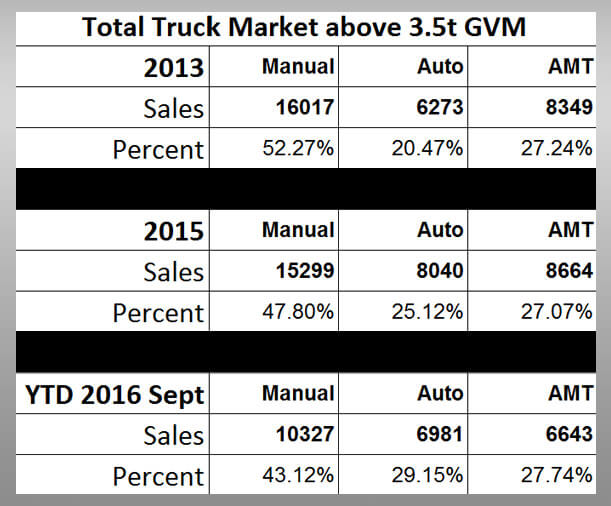
SALES of trucks equipped with automatic transmissions have surged almost 10 per cent over the past three years in the total truck market above three-and-a-half tonne gross vehicle mass (GVM).
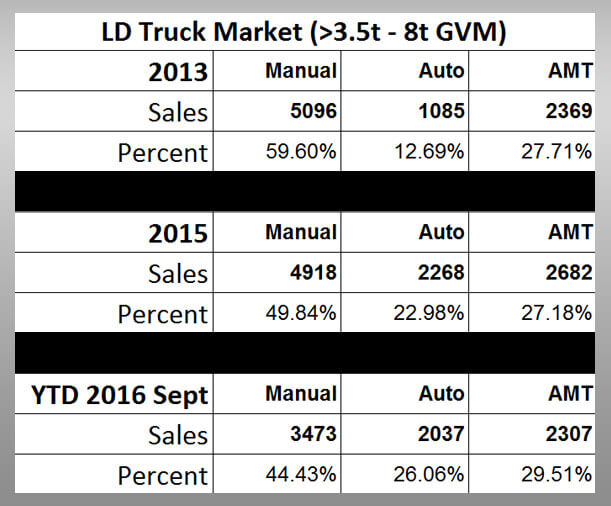
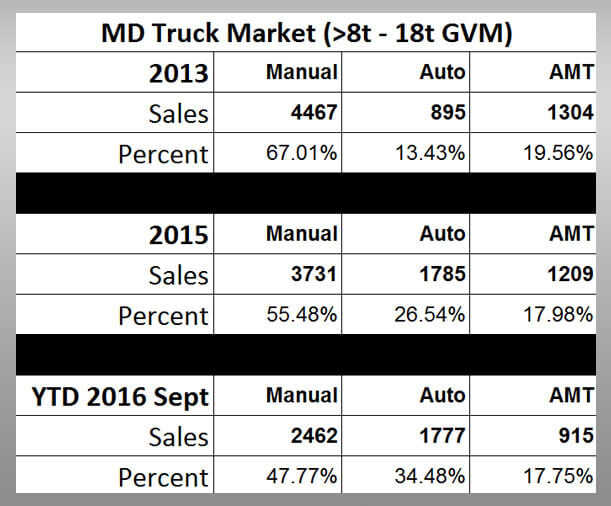
A closer look at statistics supplied by the Truck Industry Council reveal that the trend is most pronounced in the light (three-and-a-half to eight tonne GVM) and medium (eight to 18 tonne GVM) truck segments. In the light segment, automatic truck sales have risen from 12.7 to 26.1 per cent of total sales, while figures in the medium segment are even more telling with an increase from 13.5 per cent to 35.5 per cent.
Despite some extra up-front cost in purchasing an automatic truck, it’s not hard to understand why their sales are on the up while manual truck sales are down across the board.
Ease of operation for city based pick-up and delivery drivers allows them to watch the road or seek out an address rather than worry about what gear they are in. Auto trucks also mean less training for new drivers and expands the potential driver employment pool for fleet operators.

Heavy trucks remain the bastion of the AMT
Determining which type of truck transmission is best creates never-ending discussion and there are several “best” options depending on the type of truck, where it is being used and who’s driving it.
Manual transmissions are generally more robust than autos but can take some practice to drive smoothly, especially in heavy duty non-synchro applications. Jerky gear changes in a heavily loaded truck will wear the driveline prematurely. Unscheduled downtime is almost a certainty at some point with an unskilled driver.
Automated manual transmissions (AMT) represent a great option in some applications and are also gaining popularity. Effectively a traditional manual box operated by computer with no clutch pedal for the driver, AMTs can be an acquired taste.
However, an AMT usually produces smoother operation than a traditional manual and better fuel economy than an automatic.
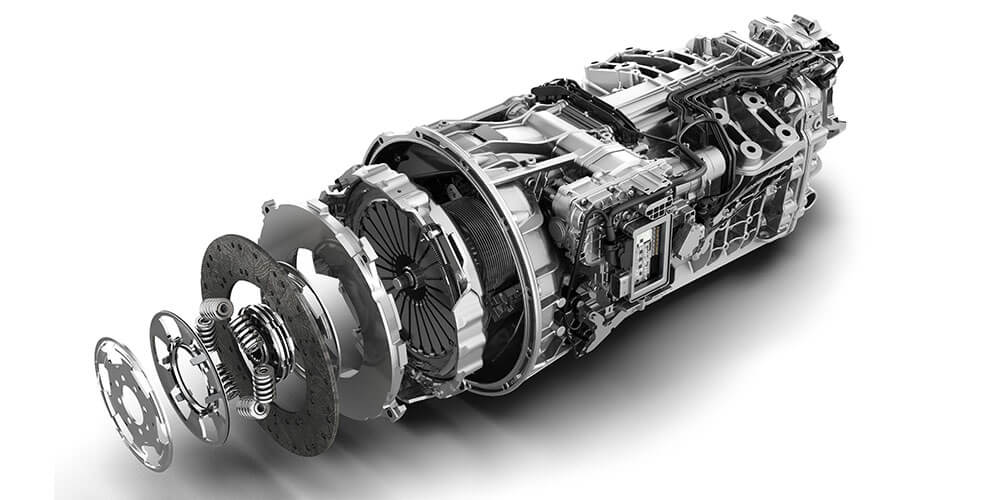
Detroit DT12 automated-manual transmission
The latter point was borne out by a recent study conducted in NSW by the Green Truck Partnership which indicated that AMT’s were about 11 per cent more fuel efficient than a manual. This equates to savings of around $8 per 100km and significantly reduced carbon emissions.
It’s not all good news for AMT or manual transmissions. There is a trend in modern diesel truck engines towards larger cylinders and lower RPM. While this has many benefits, the torque characteristics of such engines can cause surging in a transmission attached solidly to the engine via a clutch.
The surging is amplified along the driveline and can be interpreted by the engine management system as driver throttle inputs causing the transmission to hunt between gears. To combat this, some AMTs, referred to as hybrids, are equipped with a fluid filled torque converter, like a traditional auto, to absorb to torque pulsations.
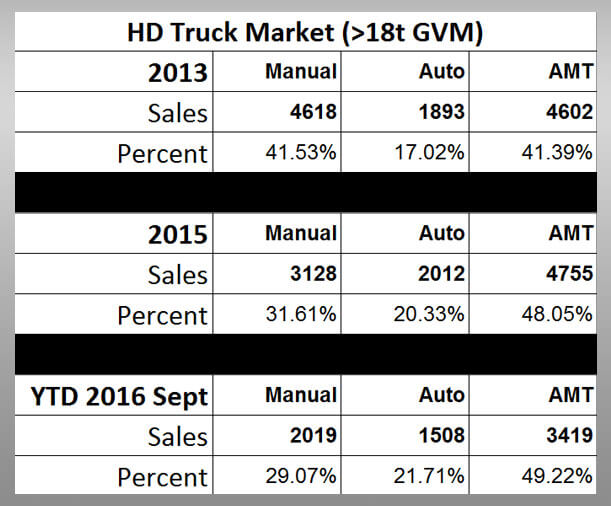
Sales of AMT-equipped trucks have remained static across the total truck market above three-and-a-half tonnes GVM for the past three years. The heavy segment (above 18 tonnes GVM) remains the bastion of the AMT where its sales have risen eight per cent in three years to a point where almost half of all heavy trucks are AMT equipped.
Regardless of which type of auto you might prefer, integration between engine and transmission is absolutely key to how well or otherwise an auto or AMT truck will perform in the real world.
Engines from one company and transmissions from another don’t always completely share all relevant data, and this can result in less than optimal gearshifts and selections.
Use of proprietary software operating systems causes this limitation but is steadily being overcome as various component suppliers, such as Cummins and Eaton, form partnerships to enable more effective integration.
Some European manufacturers, such as Scania, Volvo and Mercedes, build their own engines and transmissions, simplifying the integration task and keeping it in-house.
So when will automatic transmissions take over from manual or AMT’s in heavy, long-haul trucks?
Never, according to Mark Hammond of the Truck Industry Council.
“I doubt it, the losses through the torque convertor are just too great,” he said.
“One of the other issues with conventional automatics is their cost versus their strength. Once you get much above 300 or 350 horsepower the transmissions end up becoming physically quite large to handle the power and torque.”
A traditional automatic transmission suitable for heavy long-haul work will cost two or three times as much as a manual.
Selecting the right transmission covers a complicated range of factors: technical, human and financial. From the biggest fleet to an owner operator it boils down to costs over the useful life of the truck and whether the truck can be profitable or not.
Analysis By Daniel Cotterill









 Read More: Related articles

