


The Japanese car-maker sold 468,000 Mazda3 small cars across the globe in 2015, which represents more than one-third of its total sales, and in April this year, rolled the five-millionth car off the production line.
Mazda Motor Corporation (MMC) general manager of the product division Hitoshi Takeshita said the mid-life model has improved in handling, comfort, ride quality, noise suppression and safety “to create a brand with a special bond with customers”.
[image-comparator
left=”https://premium.goauto.com.au/wp-content/uploads/2016/08/Mazda3_Astina_2014.jpg”
right=”https://premium.goauto.com.au/wp-content/uploads/2016/08/Face_lift_Mazda3_Astina.jpg”
width=”100%”
title=”Mazda 3 Comparison”]
[/image-comparator]
Use slider bar (Above) to see the changes.
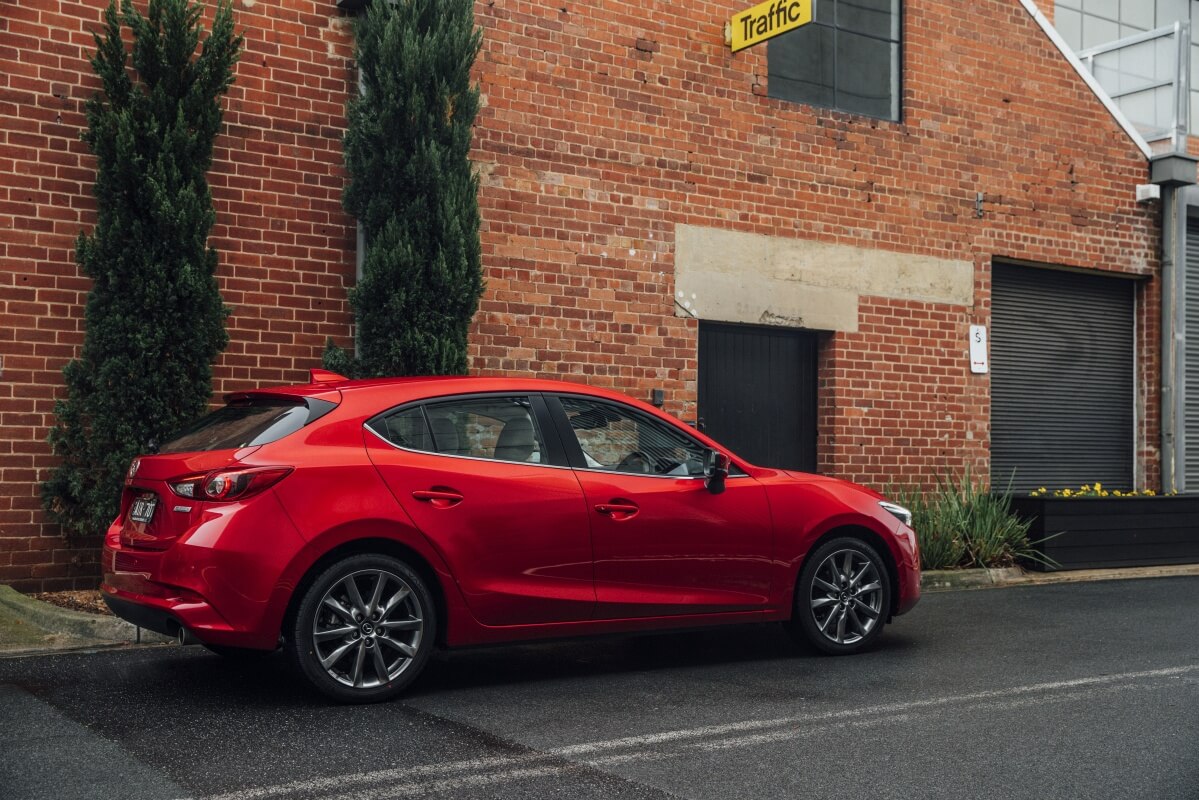
In a market where “new” is the buzzword for car buyers, the latest Mazda 3 is remarkably unchanged and externally, very few onlookers will pick it from the previous model.
There are slight changes to the shape of the spoiler and rear valance, changes made to the plastic components but not the steel panels.
Inside, the differences are more obvious when pointed out, such as the steering wheel that is now shared with the latest CX-9 SUV, a cleaner tachometer design, bigger bottle holder in the door panel and, the biggest upgrade, the replacement of the manual handbrake with an electric button on all variants barring the entry-level Neo and Maxx.

The first-generation held a 17.7 per cent market share in its segment from its 2003 debut until its second-generation replacement in 2009. The Gen-2 model increased that to 18.8 per cent, through to its 2012 update with SkyActiv technology, and then to 19.2 per cent since the introduction in June 2013 of the Gen-3 model.
Safety equipment has been improved by deleting the previous “safety pack” option and incorporating it into all grades, including autonomous emergency braking for all new Mazda3 vehicles.
However, while receiving parking sensors, the low-spec Neo misses out on a reversing camera as standard, with Mazda offering a small screen contained within the rearview mirror as a $650 option.
Interestingly, when the safety pack was available on the outgoing model, only 10 per cent of buyers paid the $1500 option price.




It is indicative of the expectation of buyers that safety is incorporated in the new car and is not viewed as an option, unlike larger alloy wheels and premium audio systems.
In addition to no changes being made to the steel body panels, the two engines – 2.0-litre and 2.5-litre petrol – and two transmissions carry over, so performance and fuel economy remain the same.
However, the diesel – selling about 50 a month – has been dropped. Mazda Australia marketing manager Alistair Doak said sales had softened in the past 18 months in line with falling petrol prices and diminished the diesel’s supremacy in running costs.

Price-dependent entry-level models – the Neo and Maxx – show a mid-year spike in sales, possibly indicating the sudden effect of user-chosen fleet buying at the end of the financial year. Once that segment was satisfied, mid-spec (Touring and SP25) and high-spec (GT and Astina) variants returned to strength.
While the diesel-powered Mazda3 does continue in other markets, Mr Doak says its return has not been ruled out if fuel prices rise.
Mazda is confident its new Mazda 3 will bring further sales growth and increased share of the small-car market despite the arrival of new or substantially upgraded competitors.
Mr Doak said Mazda was number one in the $16,000-$40,000 segment, with 36,650 units sold in the first six months of 2016, in the combined small-SUV, light-car and small-car classes.

Ball graph of Mazda and its nine main rivals shows total models from each manufacturer in the small-vehicle segments and their percentages by model type. For the first six months of 2016, Mazda claims a 13.2 per cent increase in sales compared with the same period last year, with sales reaching 36,650. Also of note is that the share of five rivals – including Toyota – have fallen. The ball graph shows the SUV, light-car and small-car mix. For example, Mazda includes the 2, 3 and CX-3. Mitsubishi has the Mirage, Lancer and ASX SUV.
“We now have different customers and different vehicles in this segment, unlike 10 years ago when the Mazda 3 represented 50 per cent of Mazda’s contribution in this segment,” he said.
Mr Doak said that although the small-car segment was the biggest sector, it was continuing to retract with the increasing popularity of small SUVs.
“But people are still interested in new (passenger) cars,” he said.
“We had a strong first half (of this year) until we ran out of stock of Mazda 3s. That was on the back of marketing including sponsorship of two of the highest-rating TV shows, Masterchef and The Voice, that put the focus back on the car segment.”

Mazda expects the mid-life update Mazda3 model to have 40 per cent of sales in the Maxx variant and 20 per cent for the entry-level Neo. It expects 57 per cent of sales to be hatchbacks and 80 per cent will be automatics. Not shown is its prediction that women will be the main buyers at 55 per cent of owners.
Since the Mazda 3’s inception in 2003, Mazda has positioned the grade levels to reflect moves in buyer taste and the repositioning of the small-car market in order to attract people downsizing yet seeking to retain a high level of luxury features.
Mazda will introduce three new colours – Eternal Blue, Sonic Silver and Machine Grey – to make eight exterior colour choices. Traditionally, the most popular choice has been Pearl White (24 per cent) followed by Soul Red (23 per cent).


Mazda, like Subaru, does not charge for metallic paint except for its halo Soul Red that has a $200 price premium.
There will again be a special-edition model, the Kuroi (it means ‘black’ in Japanese), which has a body kit, 18-inch wheels and all-black paint for an extra $2900. Mazda has sold 200 Kuroi units in the past 12 months.

Clever technology illuminates Mazda’s star
Less fatigue, more comfort and smoother handling a win for owners, says Mazda project boss

Takeshita San
MAZDA has made big noises about a new Mazda3 feature that the majority of buyers may never notice.
For owners new to the 2016 Mazda3, it will drive with an ease and a stable cornering stance likely to be expected in a brand new car.
For existing Mazda3 owners moving into the new model, it will feel sharper, more sporty and require less steering effort.
So why has Mazda put so much effort into its new G-Vectoring Control (GVC) system when it may be indistinguishable to buyers of its urban-centric, commuter-driven small car?
Mazda Motor Corporation (MMC) general manager of the product division Hitoshi Takeshita told GoAutoNews Premium that the aim was to improve occupant comfort and retain the ideology of “zoom-zoom”.
“It is important because it reduces the effort needed by the driver to make steering corrections or keep the car in a straight line, as on a freeway,” he said.
“GVC increases the comfort of the car, especially for the passengers, by reducing roll.
“For the driver, the steering is more accurate and requires less effort. It becomes a very stable vehicle, requiring less steering correction so reduces driver fatigue.”
Mr Takeshita said the thinking behind GVC was “to engage with the dynamic driver by making a better connection with the car” while also wanting “to improve the overall comfort”.
“This is what zoom-zoom is all about,” he said.
Technically, Mazda’s GVC technology is new steering and suspension geometry coupled with a reprogrammed electric-assist steering system.
It puts more weight on the front wheels when cornering to improve tyre grip and, when under acceleration, lifts the front slightly to transfer weight to the back.
Though Mr Takeshita said the variation was slight and may not be obvious in many urban driving routes, owners would be able to feel a more positive steering feel in situations such as on and off-ramps at freeways.
But for rural motorists, the car would be easier to control and require less effort in steering corrections and when cornering, he said.
The Mazda3 is the first model to incorporate GVC with the technology set to be rolled out to other models in the future.
By Neil Dowling







 Read More: Related articles


